
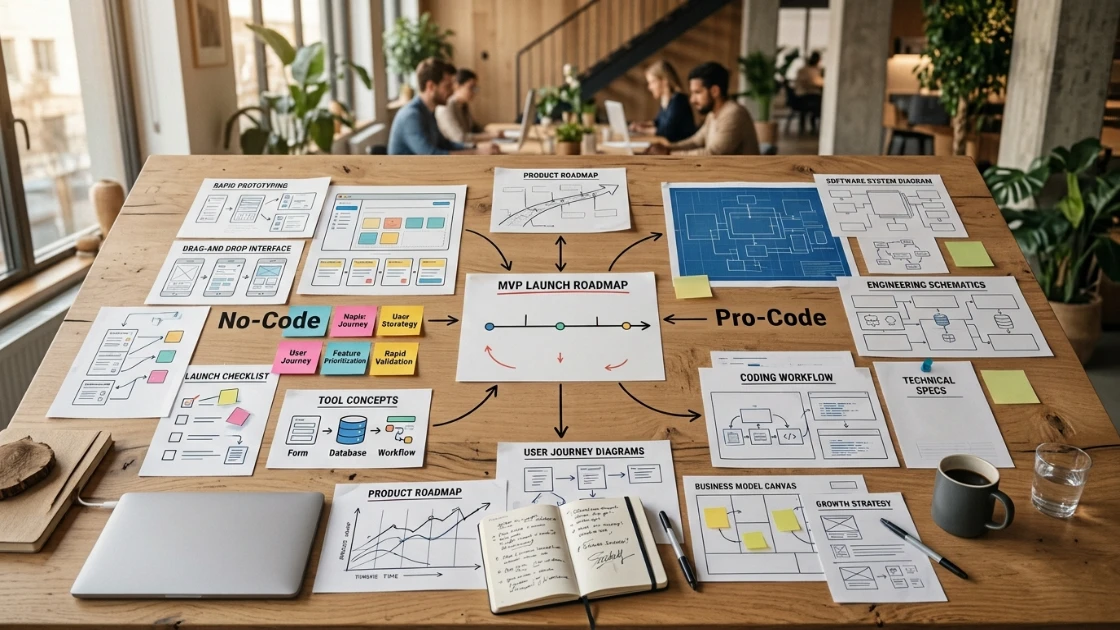
The no-code movement has democratized software creation. But for startup founders, the choice between no-code and pro-code is one of the most consequential early decisions.
The Case for No-Code
For certain use cases, no-code tools like Bubble, Webflow, and FlutterFlow are genuinely powerful:
- Speed: A landing page can be live in hours, not weeks.
- Cost: No developer salaries while validating your concept.
- Control: Non-technical founders can iterate on UI without engineering bottlenecks.
Best suited for: Landing pages, simple form-based apps, internal tools, and proof-of-concept demos for investor pitches.
The Hidden Costs of No-Code
- Vendor lock-in: Your app is trapped on Bubble's servers. Migration is extremely painful.
- Performance ceilings: No-code apps struggle with complex logic, large datasets, or real-time features.
- Feature blockers: You will hit a wall when a feature requires custom code.
- Monthly costs: Bubble and Webflow plans scale rapidly: $100-500/month at growth stage.
The Case for Pro-Code MVPs
A lean team of 1-2 engineers using modern frameworks (Next.js, React Native, Supabase) can ship a production-ready MVP in 6-8 weeks.
Benefits:
- Full ownership: You own every line of code and every infrastructure choice.
- Unlimited scalability: Your architecture grows with your user base.
- Competitive moat: Custom algorithms, integrations, and UX that competitors cannot replicate.
Our Recommendation
If you have less than $10,000 and need to validate the concept: use no-code for the demo only.
If you have $20,000+ and a validated problem: invest in a proper pro-code MVP. The compounding return of owning your stack outweighs the higher upfront cost.